1. De Tetraeder als scharnier tussen drie gebouwen
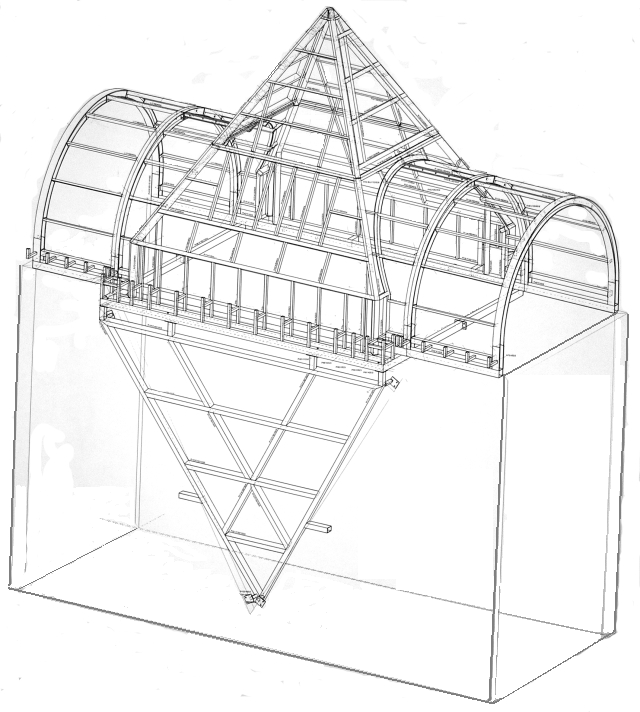
Stichting Logos beschikt over drie gebouwen, een eerste in de Kongostraat, de twee andere in de Bomastraat, die aan de achterzijde en de zijkant aanpalend zijn. De eerste kleine opname en koncertstudio ligt aan de achterzijde van het gebouw in de Kongostraat, de tweede veel grotere, kwam te liggen aan de achterzijde van het gebouw in de Bomastraat. De derde, ernaast. Funktioneel en architektonisch zou een tetraeder, met zijn typische driehoekige grondplan, perfekt funktioneren als 'scharnier' tussen de drie gebouwen en er als dusdanig een eenheid tussen scheppen. De percelen waarop beide gebouwen staan vormen immers een onderlinge hoek van ongeveer 120 graden.
De plaatsing van de koncertstudios aan de achterzijde der percelen was ingegeven door de bekommernis om het vermijden van storende straatgeluiden (bussen in de Kongostraat, vrachtwagens en zelfs -gedurende enkele jaren- een bijzonder storende dancing in de Bomastraat).
Uitdrukkelijk wijzen we er hier op dat de muzikale aktiviteiten binnen onze instelling slechts uiterst zelden geluidsoverlast kunnen veroorzaken: zij spelen zich vaak af op de grens van de stilte.
De plaatsing van de tetraeder in de scharnier tussen de drie gebouwen, verleent het gebouw een gewild sakraal karakter, dat het koncert als sociaal-ritueel gebeuren moet bevorderen.
2. De tetraeder als akoestische ideale ruimte
Het akoestische feit dat in een tetraeder geen staande golven kunnen optreden, maakt dat het een ruimte is die niet behept is met eigen voorkeuren inzake resonantiefrekwenties. Akoestische golven kunnen elkaar nooit in faze versterken en worden onder steeds wisselende hoeken door de wanden weerkaatst. Een tetraeder-ruimte is dan ook bijlange niet akoestisch dood maar wel akoestisch lineair. Bovendien kan met een minimum aan akoestisch uitgestraald vermogen een maximale ruimte worden gevuld, een eigenschap die het voor niet elektrisch versterkte instrumentisten bijzonder aangenaam maakt om erin te spelen en te musiceren. In het bijzonder voor hedendaagse en experimentele muziek, waarin het detail van het allergrootste belang is en niet de absolute geluidsterkte, is deze eigenschap van cruciale betekenis. De vorm van deze zaal is dan ook ideaal voor de funktie die zij dient te vervullen, met name die van kleinschalige koncertzaal.
3. De tetraeder als konstruktie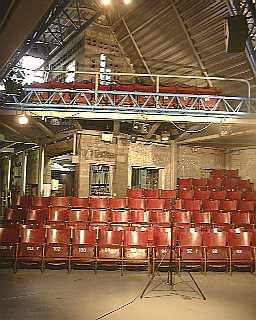
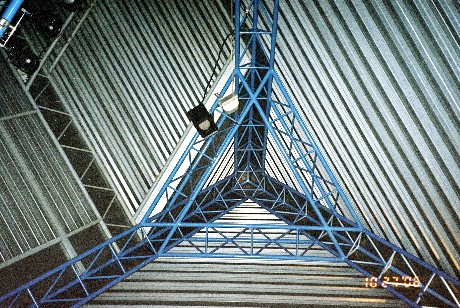
Konstruktief gezien is de tetraeder de meest efficiente vorm. Het is immers de eenvoudigste ruimtelijke figuur waarbij met een minimum aan konstruktiemateriaal een maximum volume kan worden gebouwd op een konstruktief sterke manier. Een tetraeder is omzeggens niet vervormbaar, in tegenstelling met bvb. een klassieke kubus of balk, die bij de minste zijdelingse druk overgaat in een paralellopipedum, m.a.w. traag maar zeker instort. Dit simpele feit wordt trouwens reeds lang toegepast in staal-konstruktie werk (bouw van spanten, bruggen, hijskranen o.m.), waarin men de tetraedervorm omwille van zijn mechanische stabiliteit bijna steeds terugvindt.
4. De tetraeder als energiebezuiniger
Vanuit ekologisch-energetisch standpunt gezien is het de goedkoopste ruimte die denkbaar is om te verwarmen. Zoals dat ook met het geluid het geval is, wordt de warmte van de wanden terug gestraald en gelijkmatig verdeeld over de ruimte. De ruimte wordt kleiner naar de top toe, wat uitermate efficient is vanuit verwarmingstechnisch oogpunt, aangezien warme lucht stijgt.
Voor de verwarming werd uit oogpunt van veiligheid, geluidsproduktie en flexibiliteit geopteerd voor rechtstreekse elektrische verwarming.
5. De tetraeder als estetisch koncept
Vanuit estetisch oogpunt, als architektonisch element, is de tetraedervorm bijzonder aangenaam, omdat zijn perspektivische werking zo uitgesproken is: niets dan evaderende vluchtlijnen waardoor, van buitenaf beschouwd, nooit het 'blok'- idee kan ontstaan. De tetraeder versterkt het perspektief en de diepte van het landschap en verruimt de indruk van afstand. Vandaar dat een tetraeder er ook steeds aanmerkelijk kleiner uitziet dan hij rekening houdend met zijn objektief volume eigenlijk is.
Van binnenuit, geldt dit evenwel precies andersom: door de vluchtlijnen ziet de ruimte er groter en ruimer uit dan zij werkelijk is. Stilistisch gezien zou men het ook kunnen omschrijven als een resoluut modernistisch statement in een door een bepaald grijs-roos postmodernisme verloederde en bedrogen wereld.
6. De tetraeder als element van burgerlijke ongehoorzaamheid.
Wij leven nu immers sedert meerdere eeuwen onder de diktatuur van Euclides, van de evenwijdigheid, de rechte hoek, de rechte lijn; onder de diktatuur van het infinitistische denken, de waanzinnige idee van de onbeperkte groei , van het geloof en het berusten in wat dan ook boven of buiten de mens zou kunnen staan. De tetraeder, in al zijn driehoekigheid, in zijn steeds maar snijdende lijnenspel fungeert als een symbool voor een gesloten en eindige wereld die door de mens wordt bepaald en waarvoor ook de mens alleen verantwoordelijk is. De tetraeder is dan ook een symbool voor de homo faber, een tempel van de verantwoordelijke werkzaamheid en produktiviteit.
Het is dan ook filosofisch een ideale vorm waarbinnen zich het verlichte kreatieve muzikale scheppen van vandaag zich kan afspelen en thuisvoelen.
7. De tetraeder als trefpunt van drie politieke wereldenDe drie zijden van het grondvlak weerspiegelen de drie werelden waarbinnen het hedendaagse politieke denken de wereld heeft verdeeld: de eerste - de westerse-, de tweede -het vroegere oostblok- en de derde wereld. Drie werelden die integraal in de hedendaagse muziekkultuur die Stichting Logos aan bod poogt te laten komen, zijn vertegenwoordigd.
8. De tetraeder als monument van de eenvoud
De bouw en konstruktie van een tetraeder maakt het aanbrengen van funderingen volstrekt overbodig. Zelfs bij de zwaarste aardbevingen blijft het bouwsel nog steeds overeind en behoudt het in elk geval zijn initiele en uiterst eenvoudige vorm. Dit verklaart o.m. zijn populariteit op de Amerikaanse westkust ( de San Andreas Fault), los nog van de reklame die voor tetraeder en geodetische koepel werd gevoerd door Buckminster Fuller.
De tetraeder omhult een ruimte onder gebruikmaking van niet meer dan vier vlakken, elk een gelijkzijdige driehoek. Alle driehoeken zijn volkomen kongruent. Alle onderverdelingen van de tetraeder vormen op hun beurt opnieuw tetraeders, zodat de hoofdvorm zelfs uit het kleinste detail -zolang dat tenminste een hoekpunt omvat- opnieuw rekonstrueerbaar is. Om het met Buckminster Fuller te zeggen: het is een ideale synergetische konstruktie.
9. De tetraeder als spel
In de Belgische architektuur is er weliswaar een welhaast onbeperkte variatie -ondanks de bemoeienissen van stedebouw- maar helaas zijn dit alles variaties op de stunteligheid van de achterkotterij enerzijds en het pseudomoderne betonblok of de kitscherige neo-fermette anderzijds. Een tetraeder fungeert daarbinnen als een element van fantasie en verbeelding, door zijn bedrieglijke non-funktionaliteit.
In de zomer van 2003 brachten we in de tetraeder een modernistische vloerbedekking aan: massief inox.
In 2001-2002 hadden we werken aangevat die de Logos tetraeder ook een gezicht naar buiten wilden geven. Over bouwvergunningen en uitwerkingen zijn we jaren lang in onderhandeling en diskussie geweest met de 'bevoegde' overheden. Onze stoutste plannen werden herhaaldelijk resoluut van de hand gewezen en mochten we niet uitvoeren. Dat er ondanks stedebouw toch nog zoiets als architektuur is in deze stad, mag voorwaar een wereldwonder heten. De toelichtingstekst bij onze eerste plannen laten we hier volgen:
De 'bouwkundige' geschiedenis van Stichting Logos vangt aan in 1977, jaar waarin we het burgerhuis gelegen Kongostraat 35 in Gent aankochten. In dit huis werd meteen al een verbouwing uitgevoerd waarbij een kleine opname- en koncertstudio, plaats biedend aan 49 personen, tot stand werd gebracht. In deze koncertstudio grepen in de periode 1978-1990 zowat 1000 koncerten plaats waarbij de plek uitgroeide tot een waar internationaal knoop- en kontaktpunt van de internationale muzikale avant-gardes. De kantoren van Stichting Logos waren gehuisvest op het gelijkvloers van dit pand (ze zijn daar overigens nu nog), terwijl op de tweede verdieping een elektronisch laboratorium werd uitgebouwd, gericht op experimentele elektronische instrumentenbouw. In 1986 kocht Stichting Logos het aan de achterzijde aanpalend bedrijfsgebouw, gelegen Bomastraat 26-28 aan, met het oog op een uitbreiding van haar koncertfaciliteiten en publieke funkties. In 1990 werd de thans bekende Logos Tetraeder gebouwd. De eerste speciaal voor experimentele muziek gekoncipieerde ruimte in europa. Het werd een heel bijzonder ontwerp, bijna geheel zelf gerealiseerd als gelaste staalkonstruktie. Voor de realisatie ervan werden we zelfs bedacht met de Tech-Art prijs van de Vlaamse Ingenieursvereniging. Plannen en maquettes van deze tetraeder konstruktie maakten later deel uit van 'Architektuur als Buur', terwijl het gebouw bij die gelegenheid ook publiek te bezichtigen was. Door deze uitbreiding beschikten we niet alleen over een heuse koncertzaal met 150 plaatsen, maar eveneens over een behoorlijk uitgerust atelier voor experimentele instrumentenbouw (staalkonstruktie, TIG laswerk, automatiseringsprojekten). Aan de 'gezicht' van het gebouw hadden we in al die tijd nooit iets gewijzigd, hoewel dat al lang in de bedoeling lag. Immers, de buitenkant weerspiegelt thans niets van het experimentele wat in zijn ingewanden doorlopend aan de gang is. Daar willen we nu iets aan doen. De eerste bedoeling is dan ook Logos van een architekturaal gezicht te voorzien en bovendien tegemoet komen aan de alsmaar toenemende ruimtelijke noden van de Stichting. De gelijkzijdige driehoek, basiselement van de tetraeder, kon dan ook in het ontwerp voor deze verbouwing niet achterwege blijven. Hij fungeert als ikoon voor onze werking. Het materiaal, staal en inox verwijst naar de plasticiteit en de spankracht van een resoluut moderne konstruktie. We wilden een gevel die het gebouw transparant zou maken. Zo, dat de interne werking vanaf de straat zichtbaar zou zijn. Vandaar ook een uitgebreide, licht uitstekende, glaspartij waardoorheen de bestaande draagmuur gedeeltelijk zichtbaar is en blijft. In de zo geschapen ruimte kunnen objekten (muziekautomaten, audio-art assemblages... uit eigen produktie) worden tentoongesteld. De gelijkzijdige driehoek verkrijgt daardoor een funktionaliteit die zijn louter ikonische waarde overstijgt. Zoals voor alle bouwprojekten die Logos in het verleden ondernam, deden we ook voor dit -afsluitende en bekronende- projekt een beroep op Ir.Arch.Raymond Van Soens, een architekt die zelf ook sedert jaar en dag heel wat voeling heeft met de wereld van de eigentijdse muziek, en beter dan geen ander in staat bleek onze ideeen uit te werken en die vorm te geven, die realizeerbaarheid met beperkte en eigen middelen mogelijk maakt.
Nadat de we kater van de even onzinnige als onrechtvaardige afwijzing van dit architektuurprojekt door stedebouw moeizaam hadden verteerd, namen we in augustus 2004 opnieuw een initiatief. Een nieuw ontwerp ook... De vervlakking geeist door stedebouw werd hier radikaal doorgevoerd: het gevelontwerp heeft geen uitstekende delen meer. De gelijkzijdige driehoek werd behouden. Helaas voor stedebouw is die niet bij wet verboden. De materiaalkeuze: inox, al evenmin. De bouwaanvraag werd in september 2004 opnieuw ingediend... In juli kwam dan , alweer, het bericht dat de aanvraag werd afgewezen. In september werd de definitieve weigering ons betekend. Deze keer omdat het ontwerp niet in overeenstemming zou zijn met de vereisten gesteld door de brandweer! En dat ondanks het feit dat in dit gebouw uitgerekend geen enkel brandbaar materiaal wordt gebruikt en er ook geen brandvoedende substanties in aanwezig zijn! Bovendien schijnt het tot de brandweer nog niet te zijn doorgedrongen dat de brandbaarheid van een gebouw in eerste plaats evenredig is met de boekhoudkundige situatie van de eigenaar veel meer in elk geval dan dat ze afhankelijk zou zijn van onzinnige vereisten zoals kompartimentering, gebruik van beton e.d.m. Voor de derde keer dienden we dan maar opnieuw een aanvraag in , we schrijven september 2005... En nu, alweer, afwachten maar...
We zijn dan maar alvast aan de slag gegeaan met de uitvoering van het ontwerp van het nieuwe sanitair in de tetraederzaal. In september waagden we het toch al, het door en door rotte raamwerk op de 1e verdieping en de voordeur te vernieuwen... Ook alle nog resterende en door huiszwam zwaar aangetaste hout werd uit het gebouw verwijderd.
In 2006 kregen we uiteindelijk toch een bouwvergunning. In de zomer van 2007 werden de konstruktiewerken gestart. Het nieuwe gebouw -volledig uitgevoerd in roestvast staal- werd in gebruik genomen worden in de lente van 2008. De uiteindelijke volledige afwerking zal echter nog een heel tijdje moeten wachten, en eerste plaats vanwege akuut geldgebrek...
Het hele bouwproces kan worden gevolg op ons web-bouw-dagboek.
In 2011 kochten we het aanpalend pand, Bomastraat 24, en begonnen we aan de inrichting ervan als tweede performance ruimte en een verblijfplaats voor artists in residence. Deze Logos Loods werd voorzien van een nieuwe vloer in gepolierd beton.
Dr.Godfried-Willem RAES
Laatst bijgewerkt op 2016-05-24
Logos Tetrahedron
The Logos Foundation has built a unique new concert
hall right in the centre of Ghent, Belgium. It can seat up to 150
people and is fully equipped with a sound and light infrastructure.
This hall constructed in 1990 is situated in a building adjacent
to the recording studio, which has been operational since 1977.
As one would expect from Logos, this hall is exclusively used for
contemporary and experimental music, including electronic and computer
music. It is the best space available for these types of music (both
technically and acoustically) in the country. That is why it presents
about 65 concerts a year, and why musicians who are serious about
their music come to Logos…
The Logos Foundation has opted for a unique design: the tetrahedron, a shape whose sides are four equilateral triangles (comparable to a pyramid, but with a triangular instead of a square base). The location of the tetrahedron as a hinge between the three buildings of the Foundation gives the whole space an intentionally "sacred" character, which should emphasize the concert as a social and ritual event.
The acoustic fact that no standing waves can occur in a tetrahedron makes it a space without preferences for certain resonance frequencies. Acoustic waves can never amplify one another in phase and are reflected by the walls under ever-changing angles. A tetrahedron space is not at all acoustically dead, but rather acoustically linear. Acoustic efficiency is another big advantage of such a space: a maximal space can be filled with a minimal amount of acoustic output power, a quality that makes it very convenient for musicians not using any electronic amplification. In particular for contemporary and experimental music, where the transparency of detail more than the absolute sound level is of the utmost importance, this quality is highly meaningful. The shape of the hall is therefore ideally suited to its purpose: to serve as a concert hall.
From an aesthetic point of view, as an architectural element, the tetrahedron is quite pleasant because its visual perspective is so pronounced: nothing but evading lines, such that you never get the idea of being enclosed in a box. The tetrahedron amplifies the perspective and the depth of the landscape and broadens the impression of distance. This is the reason why a tetrahedron seen from the outside always looks smaller than it actually is, considering its objective volume. From the inside, just the opposite holds true: because of the evading lines the space looks larger than it really is. One could also describe it as a resolutely modernist statement in a world that has been deceived by a certain grey/pink postmodernism…
The Logos tetrahedron is one of the very few concert halls built by musicians themselves. Musicmaker Dr.Godfried-Willem Raes, the director of the Logos Foundation, was its designer. The actual realization of the building too (welding, cementing, plumbing, painting etc.) was done by the Logos work group. They spent six months in 1990 tearing down the old factory buildings and then it took them another half year to erect the new space using steel, concrete and plate metal. The balcony is covered by transparent grids in such a way the whole construction appears extremely light and elegant. The metal roof is entirely covered from the outside by thick layers of insulating and dampening polyurethane.
The opening of the Tetrahedron, in 1991, was celebrated with a three-day festival, for which Logos commissioned new tetrahedron-related compositions from twenty Flemish and Walloon composers. At the opening ceremony, the Governor of Flanders, Herman Balthasar, inaugurated the concert hall and for three days in a row, prominent citizens, musicians, composers and music lovers alike celebrated the unique event with a tremendous feast of music.
In 2003 the hall was given a novel floor, made of very thick high quality stainless steel. It even improved the acoustics.
Technical notes and infrastructure survey for musicians
In 2004 we took up the plans again for the renovation of the front (street) side of the Logos building. The new building is made of stainless steel and lots of polycarbonate. In August 2005 we started work on the renovation of the sanitary facilities (rest rooms etc.). In 2006 went through the tough process of getting the required permits from the local authorities. We got these by the end of the year. The practical work started in the summer of 2007, and we celebrated the opening of the new facade in December 2008. A first rough sketch of the new construction on the street side looks like:
In 2011 we bought the adjacent building (Bomastraat 24) in order to expand the usefull surface of our facilities. This new performance space became known as the Logos Lodge. It is a flexible space with a pollished concrete floor and lots of daylight flowing in. This part of the building also accomodates an appartment for artists in residence, storage space for our large projects and exhibition space for audio-art presentations.
Last updated: 2016-05-24